Supported by the LOC3G program, Dr. Tao Hu from Prof. Wei Wu’s research group at the Institute of Geotechnical Engineering, BOKU University, Vienna, carried out an academic visit to the International Centre for Numerical Methods in Engineering (CIMNE) from March to April 2026. During the visit, he was hosted by Prof. Alessandro Franci and engaged in a series of academic exchanges with CIMNE researchers, contributing to ongoing collaborative research activities.
During the visit, Dr. Tao Hu presented his recent research on two main topics: neural network-based constitutive modelling and hypoplastic modelling of granular materials exhibiting solid- and fluid-like behaviours.
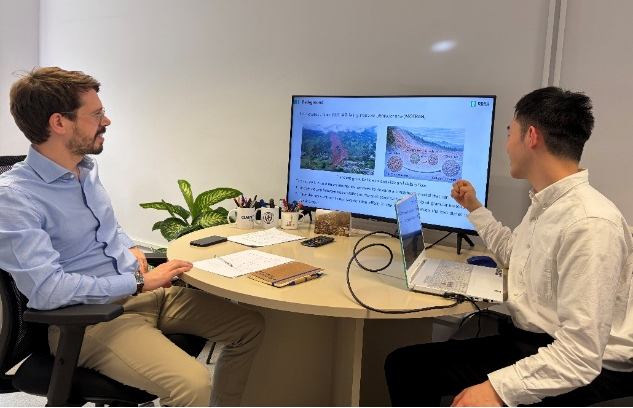
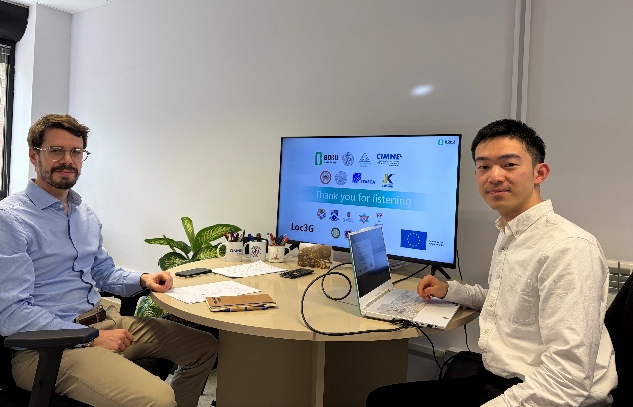
Presentation by Dr. Tao Hu at CIMNE
For the neural network-based constitutive modelling, a transfer learning framework was developed to address the challenge of accurately describing the mechanical behaviour of gas hydrate-bearing sediments with diverse characteristics. By leveraging large datasets generated from modified theoretical constitutive models together with limited experimental triaxial test data, a surrogate neural network model was trained using only a small set of measurable material parameters. The model demonstrated strong predictive capability across different types of hydrate-bearing sediments. Furthermore, to capture path-dependent behaviour, the training data were reformulated as time-series data and integrated with Gated Recurrent Unit (GRU) modules. The resulting model requires only four measurable parameters while maintaining high prediction accuracy, highlighting its potential for numerical implementation and engineering applications.
In the second topic, Dr. Hu presented his work on hypoplastic constitutive modelling for transient granular flow behaviour. In natural hazards such as landslides and debris flows, granular materials exhibit transitions between solid-like and fluid-like states, where particle interactions shift from friction-dominated to collision-dominated mechanisms. Existing models often treat these states separately and fail to capture acceleration effects during transitions. To address this, a rate-dependent constitutive model incorporating both hypoplastic quasi-static behaviour and acceleration effects was introduced. Numerical simulations demonstrated the model’s capability to reproduce key phenomena such as dilatancy, liquefaction, and Bagnold-type flow under accelerated shearing conditions. Discussions with Prof. Franci and Dr. Juan Marcelo Gimenez further provided valuable insights into numerical implementation aspects.
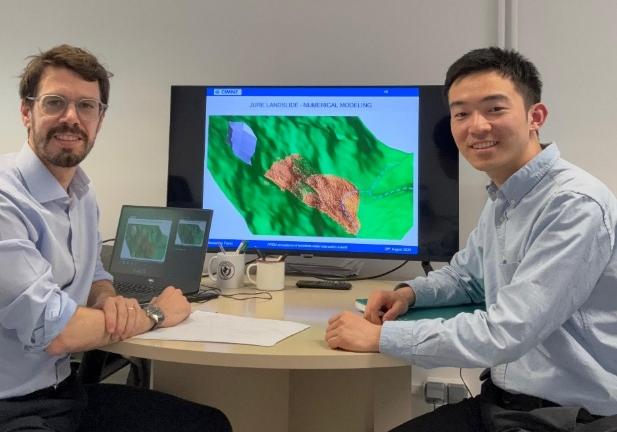
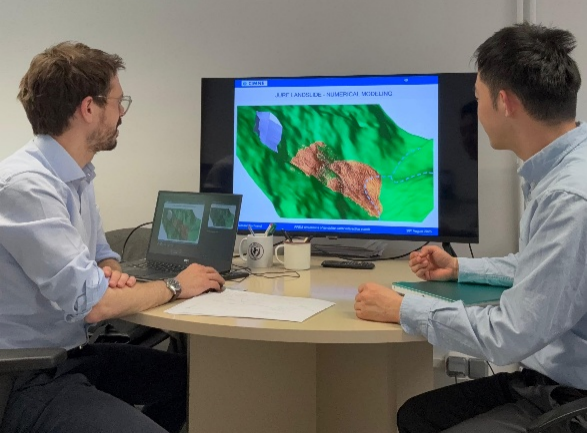
Presentation by Prof. Alessandro Franci at CIMNE
Prof. Alessandro Franci introduced the Particle Finite Element Method (PFEM), a numerical framework developed for problems involving large deformation, free-surface flows, and fluid–structure interaction. By adopting a Lagrangian description and continuously remeshing through Delaunay triangulation and α-shape techniques, PFEM effectively avoids mesh distortion issues typical of conventional finite element methods. Its applications to complex problems such as landslide-induced waves and large-scale geohazards were also presented, including the well-known Vajont reservoir case and Jure landslide.
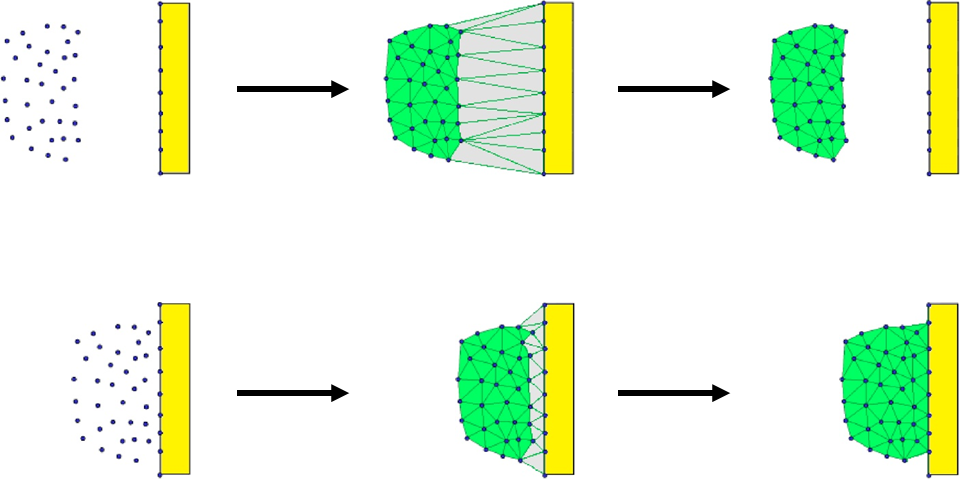
Detection of an interface with the PFEM
In addition, Prof. Franci presented ongoing research on machine learning-based multiscale modelling. Traditional multiscale approaches rely on computationally expensive DEM simulations to derive constitutive relations for FEM analysis. To improve efficiency, they are developing surrogate neural network models trained on DEM datasets to replace direct simulations, enabling faster and scalable multiscale analysis.
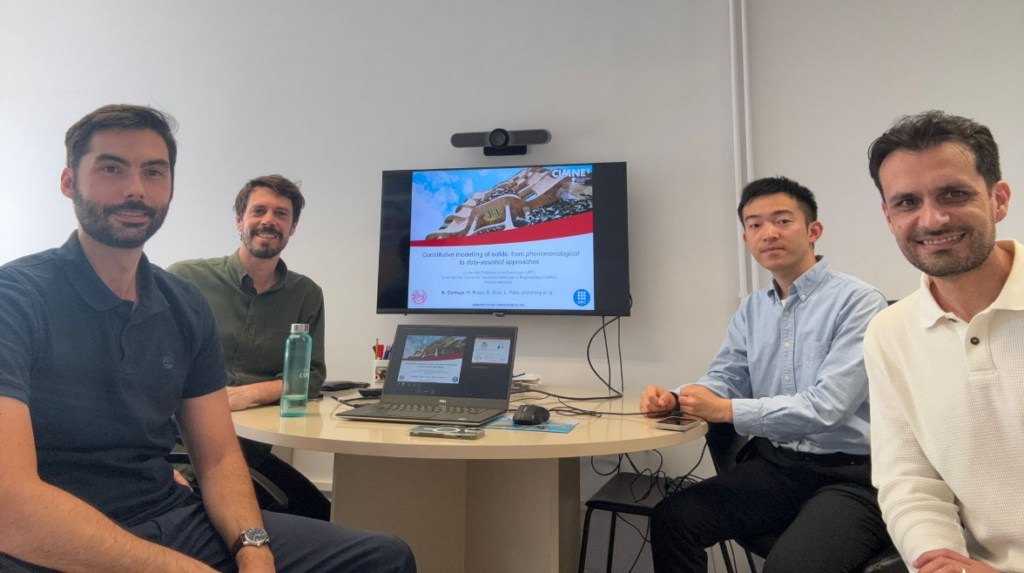
Presentation by Prof. Alejandro Cornejo at CIMNE
Prof. Alejandro Cornejo was also invited to present his group’s recent work on machine learning in constitutive modelling. Their research includes neural network-based calibration of hyperelastic model parameters, as well as the development of surrogate data-driven constitutive models based on physical constraints, such as strain invariants and energy potentials. Additionally, they explored the use of Kolmogorov–Arnold Networks (KAN) for symbolic regression, enabling approximate explicit relationships between model parameters to be identified.
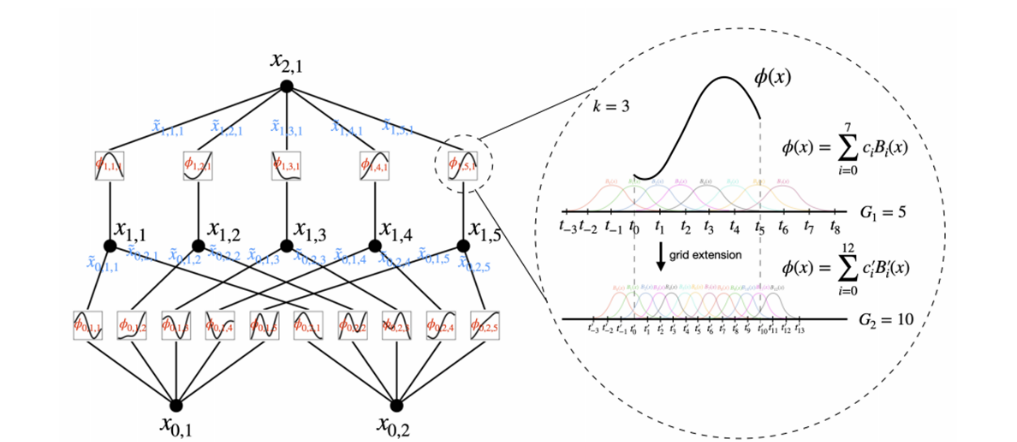
Hierarchical structure and basis function expansion in the KAN
Overall, the visit strengthened academic exchange between BOKU University and CIMNE, facilitated discussions on advanced constitutive modelling and numerical methods, and contributed to the development of collaborative research within the LOC3G framework.