On 9 July 2026, the Institute of Geotechnical Engineering at BOKU University, coordinator of the LOC3G project, hosted an academic seminar on geomechanics and geophysics, bringing together researchers from BOKU University, Warsaw University of Technology, and Nazarbayev University. The seminar provided a focused forum for exchanging current research in geotechnical engineering and related computational methods. The programme combined institutional context with technical presentations, allowing participants to identify common interests in laboratory testing, field monitoring, numerical simulation, sustainable ground improvement, and unsaturated-soil behaviour. The event contributed to the LOC3G objectives of international knowledge exchange and interdisciplinary collaboration in geophysics, geohazards, and geoengineering.
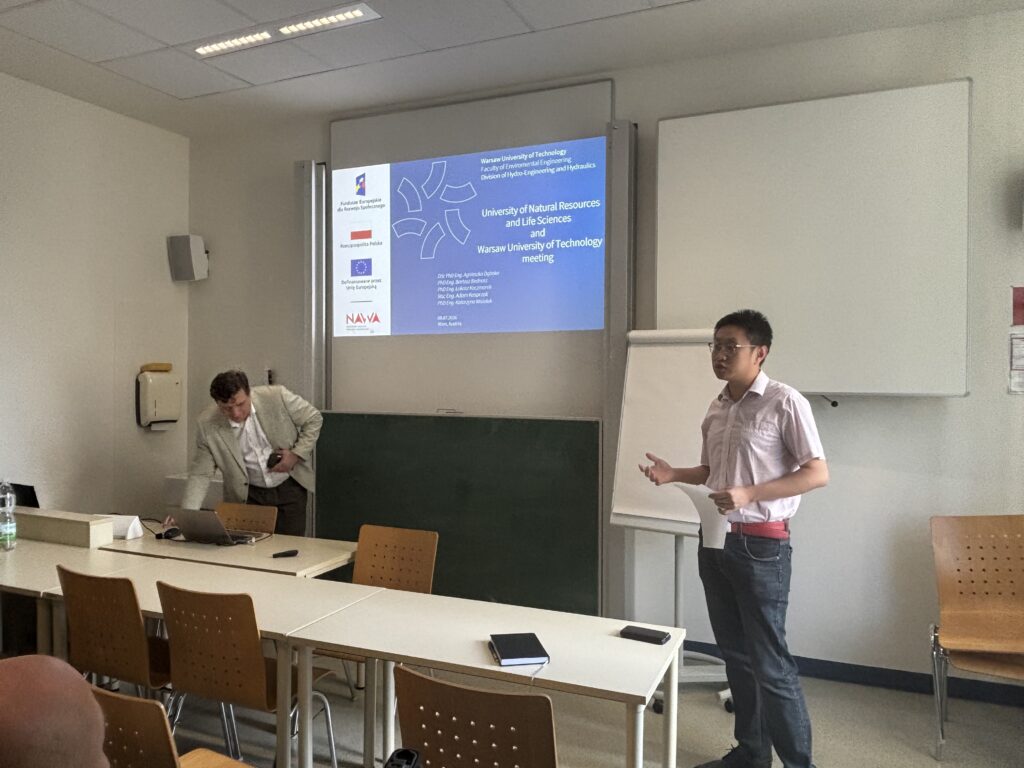
Opening remarks and seminar introduction by Dr. Yunteng Wang.
Academic Presentations and Discussions
(1) Łukasz Kaczmarek
Affiliation: Warsaw University of Technology
Presentation focus: Soil mechanics, filtration, geohazards, and reuse of geomaterials
- Presented a research portfolio linking laboratory soil testing, hydro-mechanical characterization, numerical modelling, and geohazard assessment.
- Discussed triaxial creep and strength testing of glaciotectonically disturbed stiff clay, with relevance to parameter identification and slope-stability evaluation.
- Highlighted hydraulic-conductivity testing in a triaxial apparatus, including the influence of effective radial stress, hydraulic gradient, and boundary conditions on measured permeability.
- Connected landslide and surface-creep analysis with numerical modelling and monitoring, illustrating how site observations support stability assessment.
- Included applied environmental-geotechnical research on the reuse of lime-softening sludge as a potential landfill liner material.
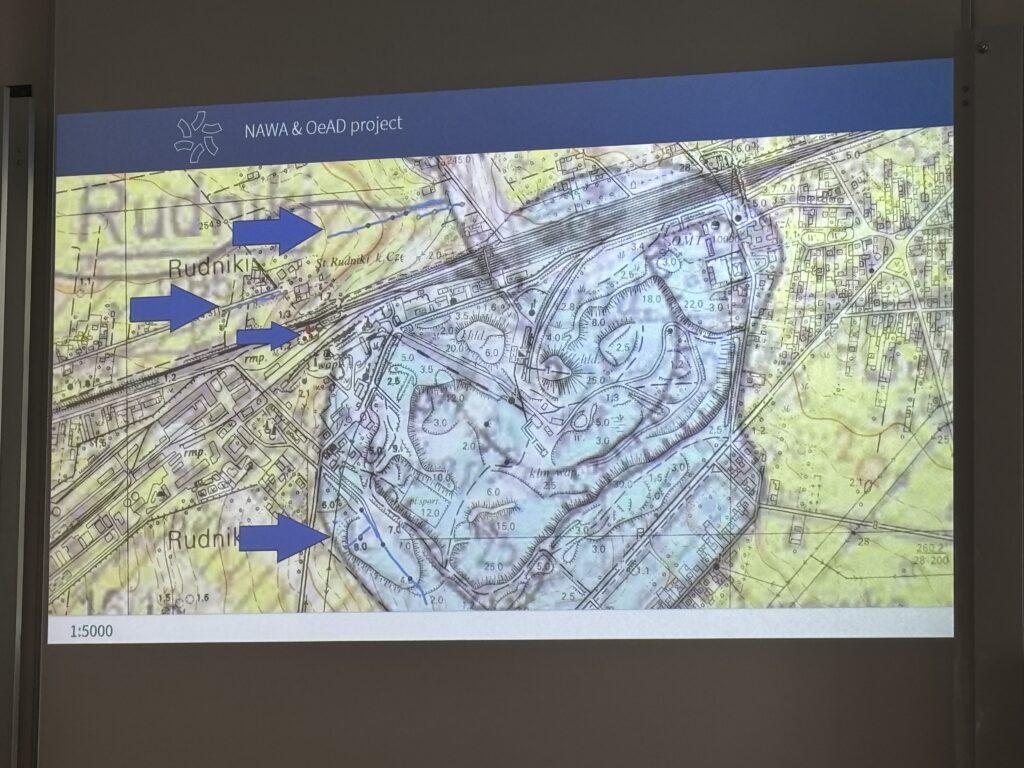
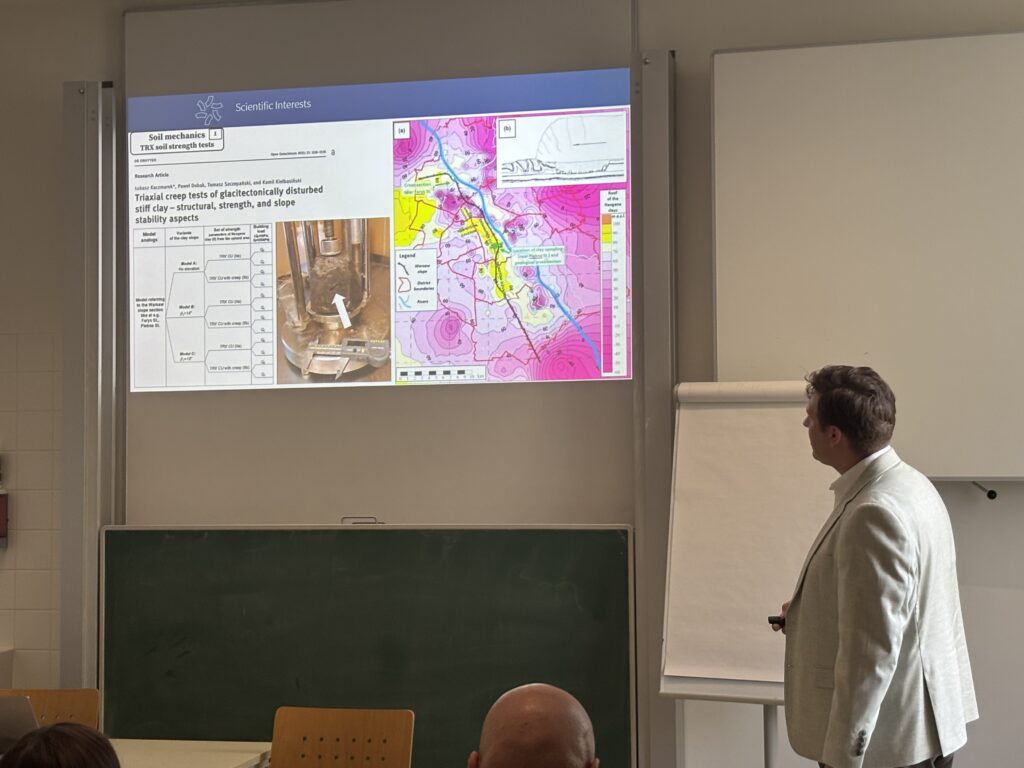
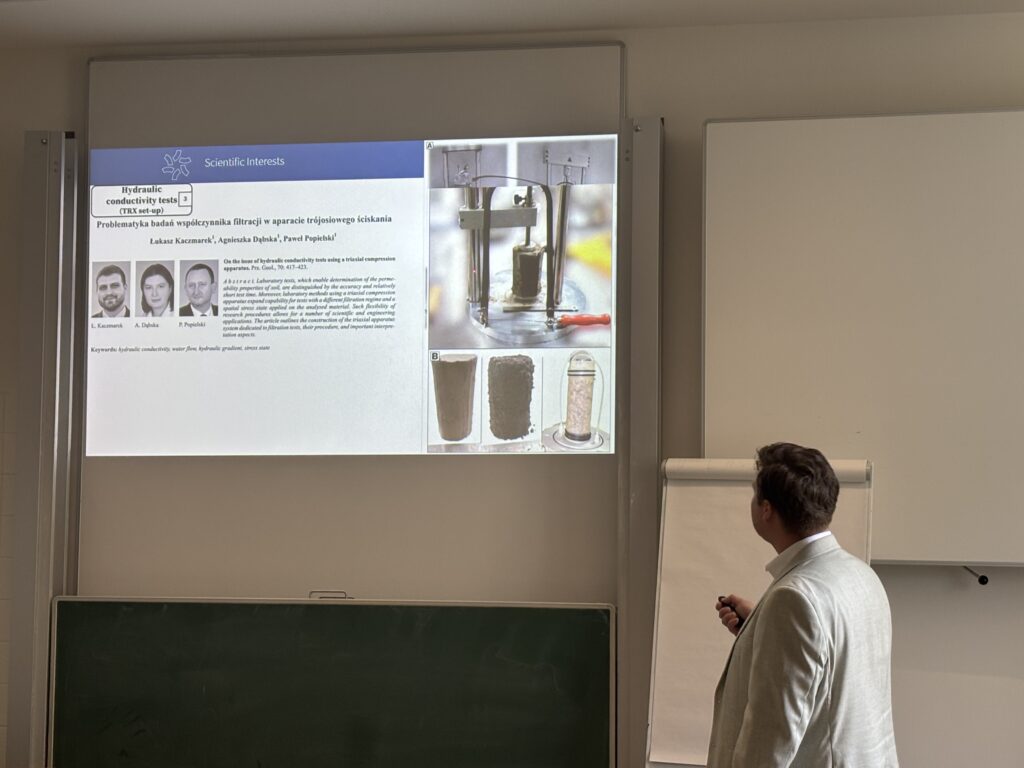
Łukasz Kaczmarek’s presentation on laboratory testing and geotechnical applications.
(2) Agnieszka Dąbska
Affiliation: Warsaw University of Technology
Presentation focus: Warsaw University of Technology and research context of the Polish delegation
- Introduced Warsaw University of Technology as a major technical university in Poland and provided the institutional background for the Polish delegation.
- Positioned the WUT presentations within a broad academic framework involving civil engineering, hydroengineering, geotechnical engineering, and infrastructure-related research.
- Emphasized the role of university-based research in connecting laboratory experimentation, field observation, numerical modelling, and engineering practice.
- Framed the seminar as a basis for future academic exchange among WUT, BOKU University, Nazarbayev University, and the participating research groups.
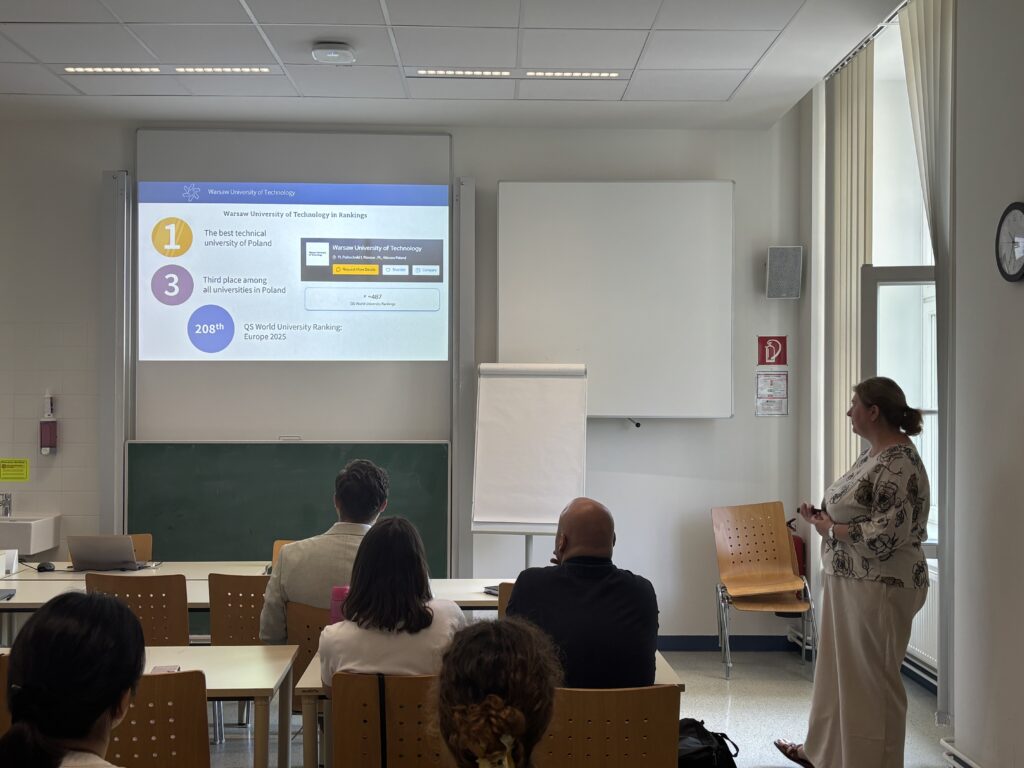
Institutional introduction to Warsaw University of Technology.
(3) Katarzyna Misiołek
Affiliation: Warsaw University of Technology
Presentation focus: Sustainable geotechnics and bio-mediated soil improvement
- Outlined a sustainable-geotechnics research direction focused on bio-mediated soil improvement, nature-based engineering solutions, and climate-resilient geotechnical practice.
- Presented microbially induced calcium carbonate precipitation (MICP) as a mechanism for improving soil behaviour through biologically mediated calcite formation.
- Used SEM observations to demonstrate calcite bridges between particles, indicating how microbial activity can modify soil fabric and generate inter-particle bonding.
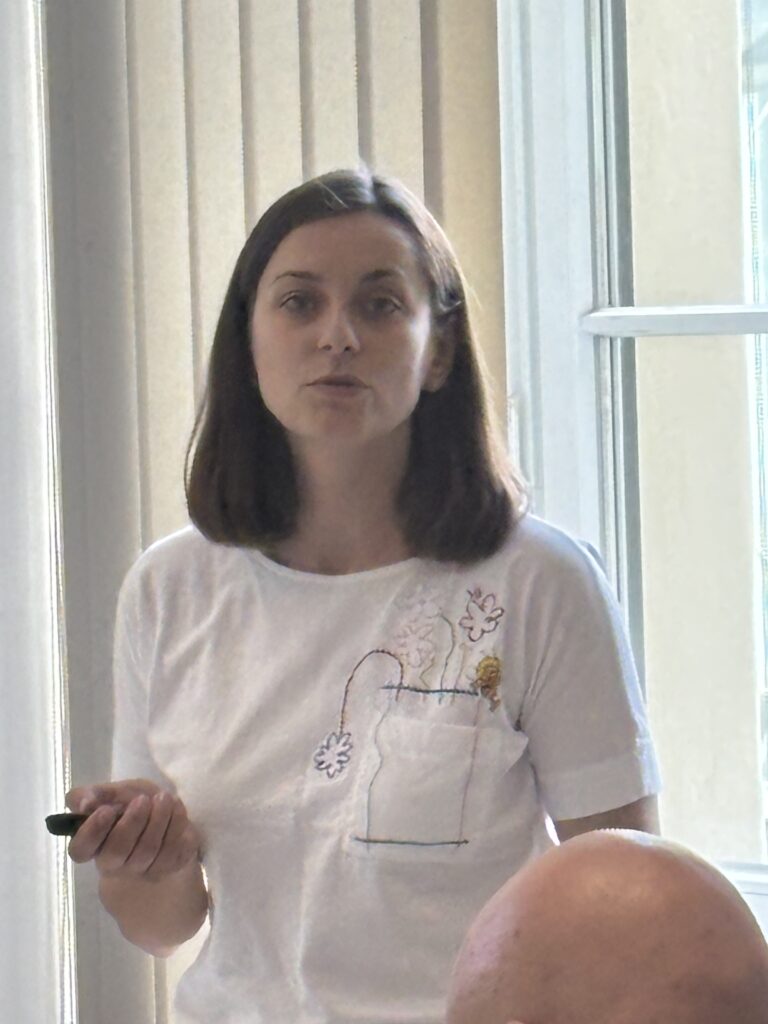
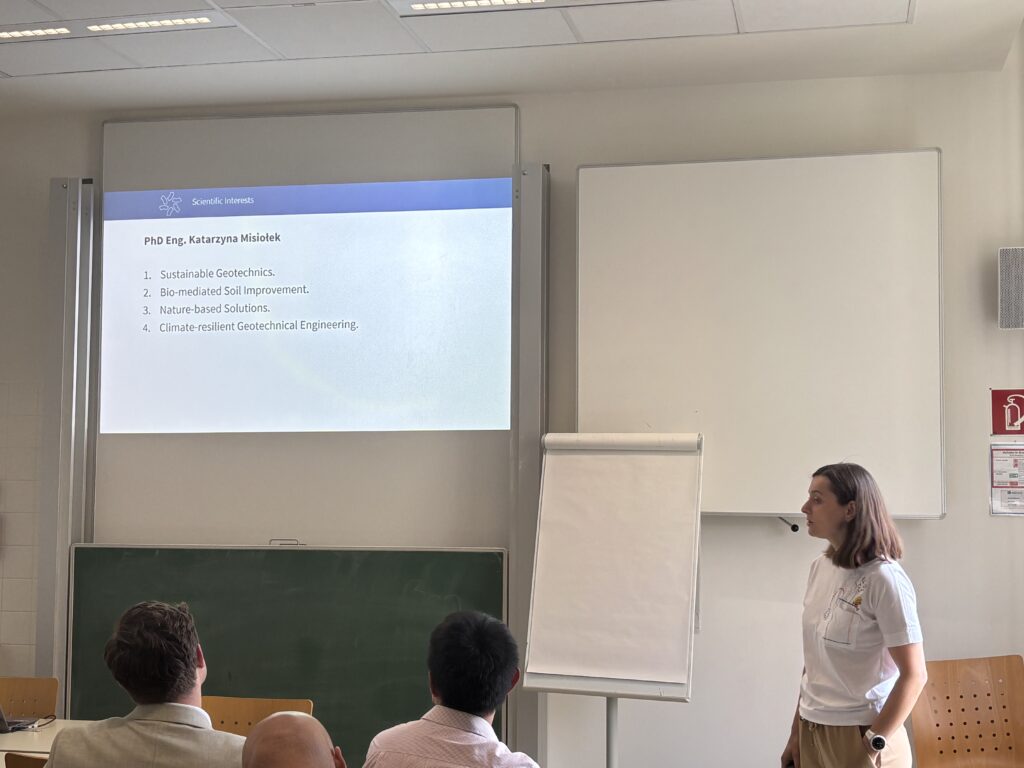
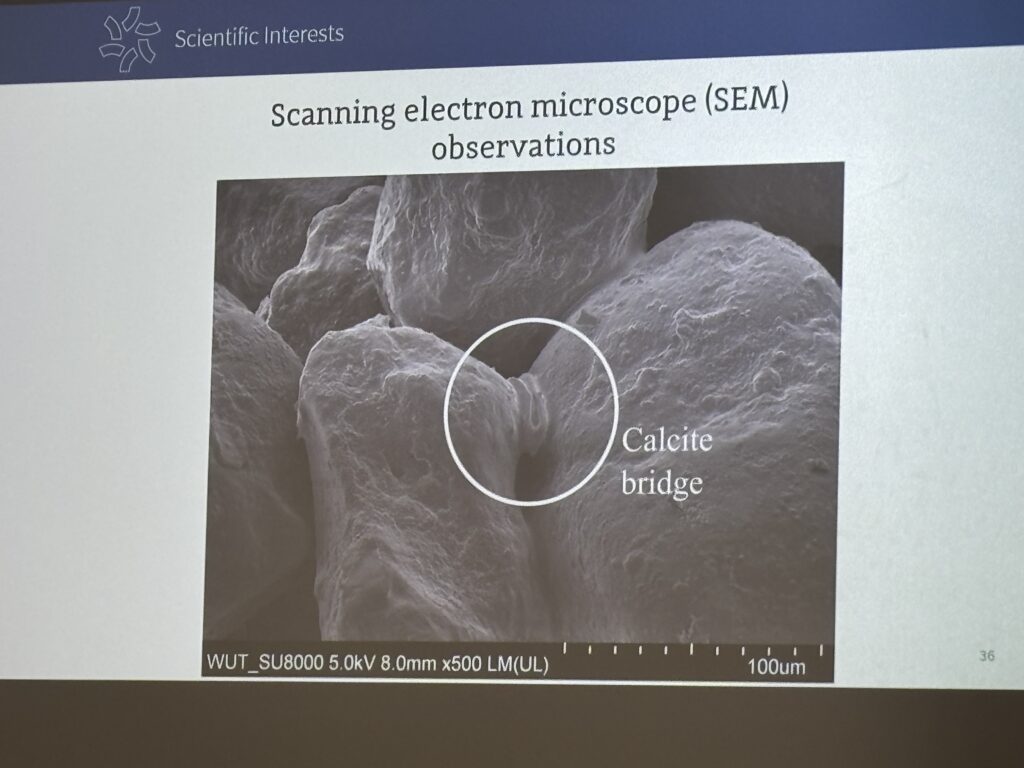
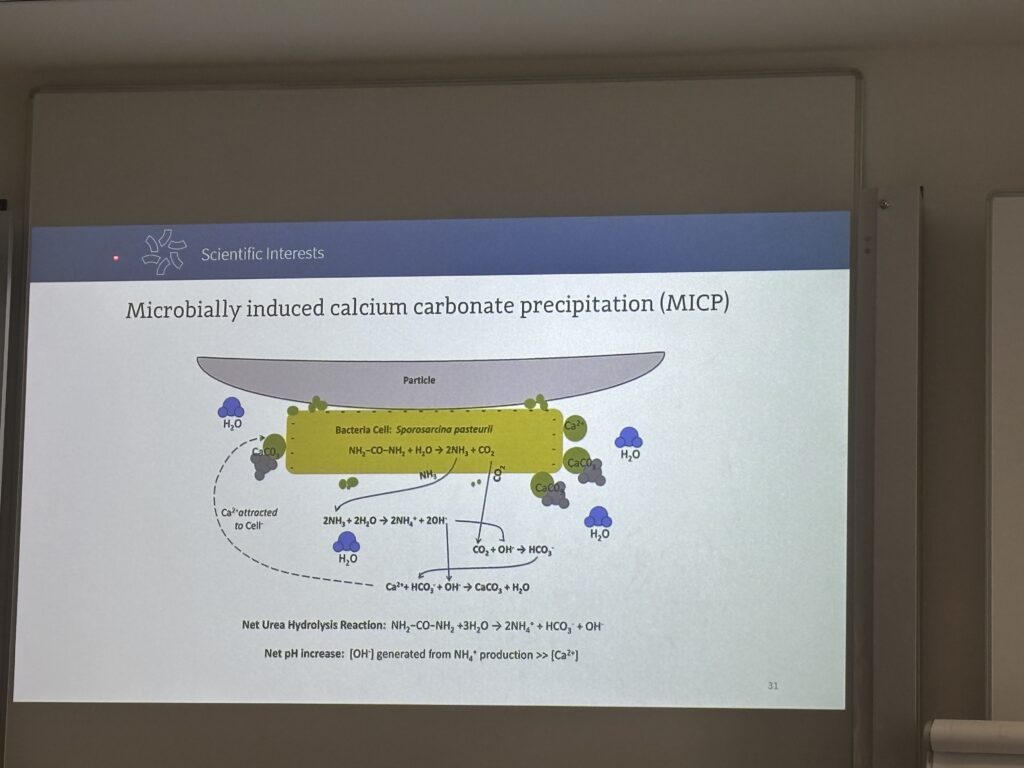
Katarzyna Misiołek’s presentation on MICP.
(4) Bartosz Bednarz
Affiliation: Warsaw University of Technology
Presentation focus: Filtration modelling, distributed fibre optic sensing, and underground infrastructure
- Presented filtration modelling and distributed fibre-optic sensing for underground and hydraulic infrastructure.
- Examined soil–water–structure interaction, seepage-induced deformation, and piping in sands.
- Highlighted the combined use of numerical analysis, monitoring, and geotechnical interpretation for infrastructure risk assessment.
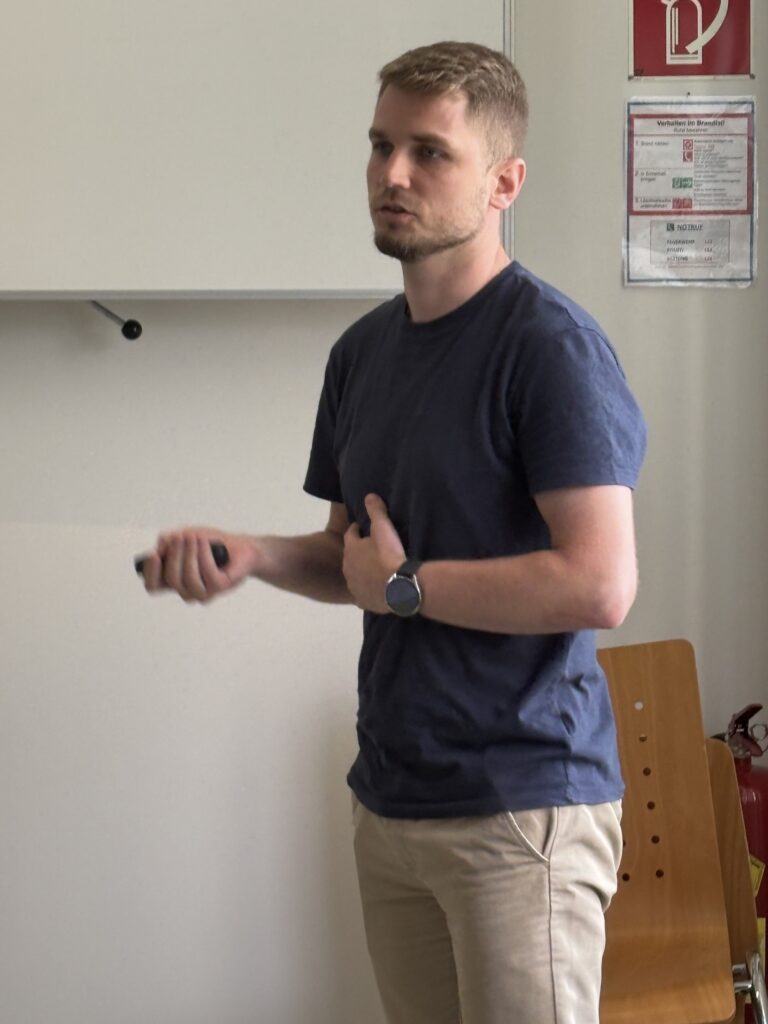
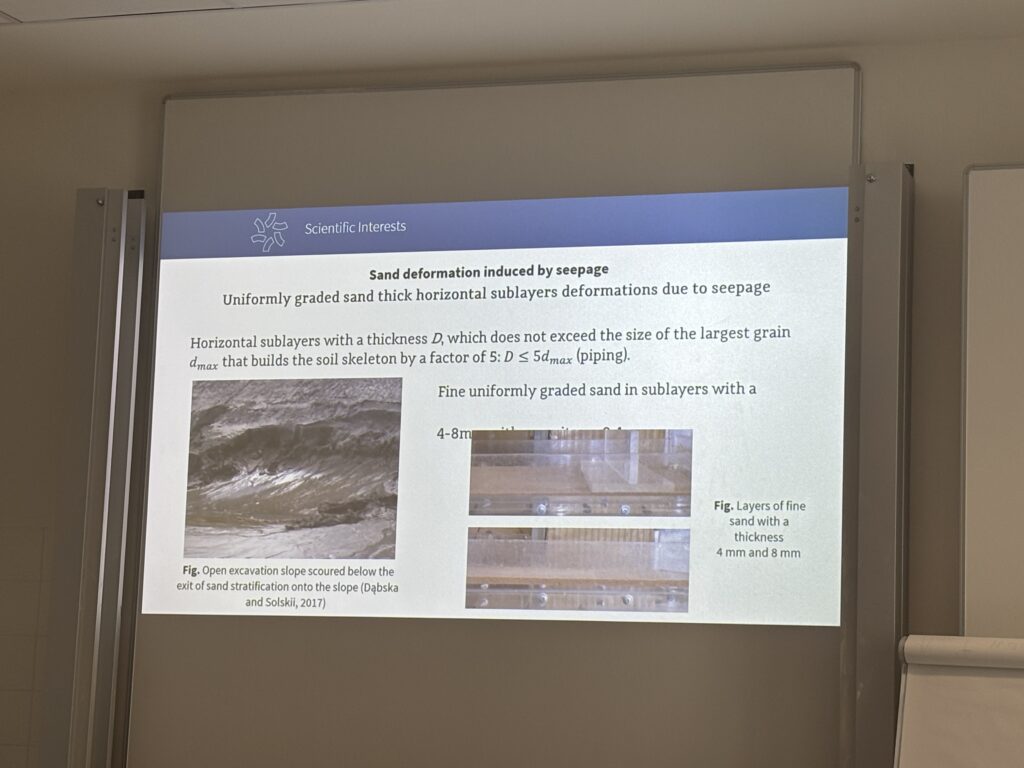
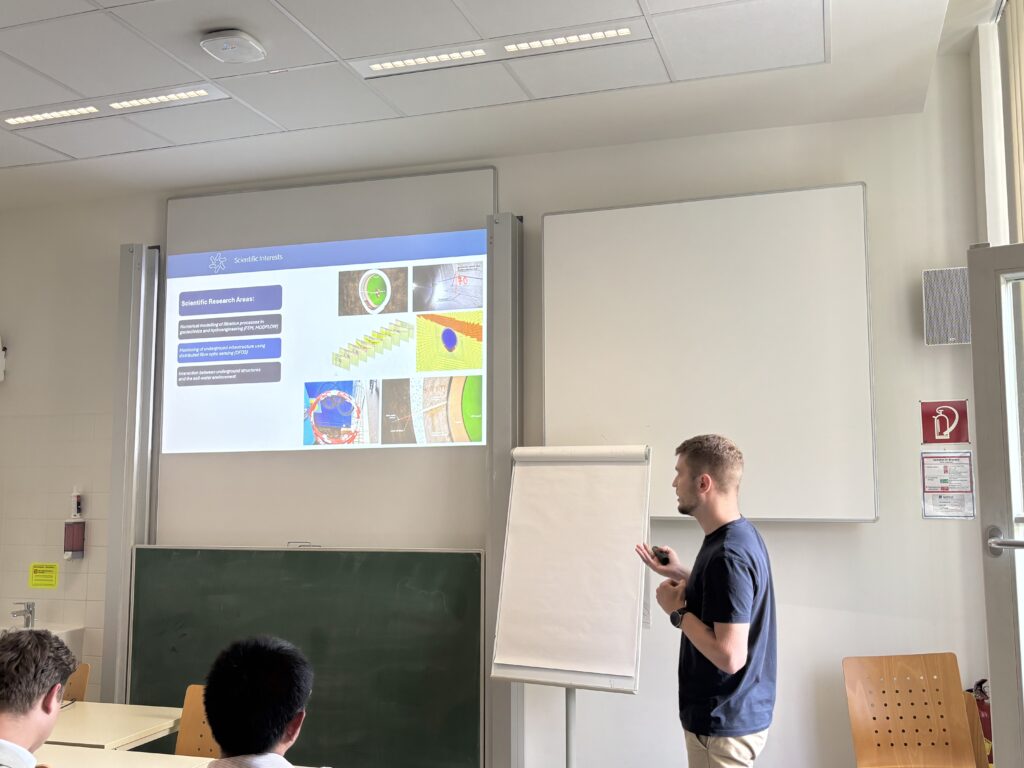
Bartosz Bednarz’s presentation on geotechnical monitoring and filtration.
(5) Adam Kasprzak
Affiliation: Warsaw University of Technology
Presentation focus: Soil-structure interaction, deep excavations, monitoring, and geohazard safety analysis
- Emphasized geotechnical and structural monitoring as an evidence base for validating numerical models and supporting observational design in urban excavation projects.
- Connected embankment, slope, and landslide safety analysis to broader geohazard assessment, where field interpretation and stability calculations inform engineering decisions.
- Demonstrated an applied research orientation in which modelling, monitoring, and safety evaluation are combined to assess complex geotechnical systems during construction and service.
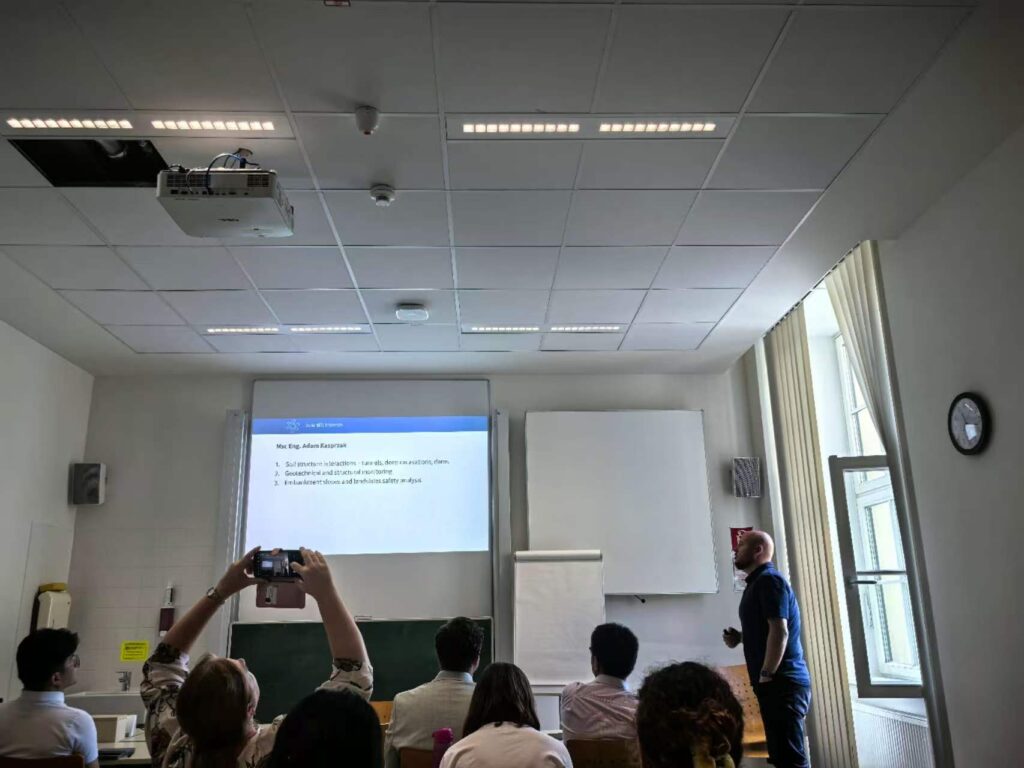
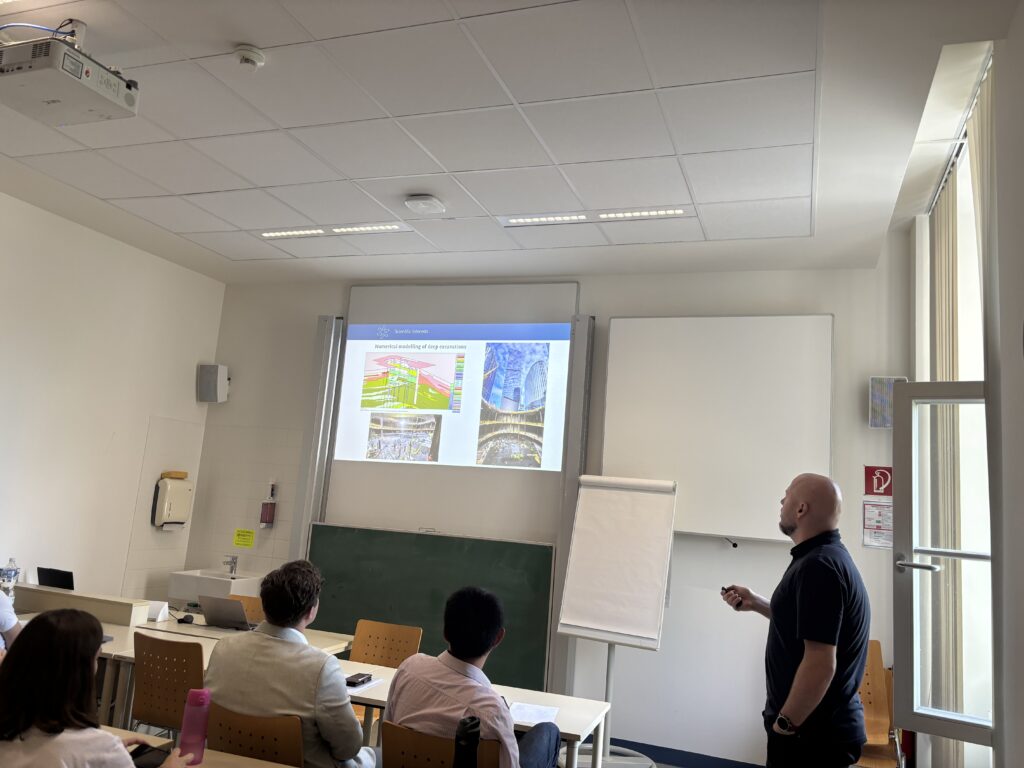
Adam Kasprzak’s presentation on soil-structure interactio
(6) Saltanat Orazayeva
Affiliation: Nazarbayev University
Presentation focus: Nazarbayev University and unsaturated-soil research team overview
- Introduced Nazarbayev University and its School of Engineering and Digital Sciences.
- Summarized research on SWCC/SFCC, geobarriers, pile foundations, geohazards, sensing, polymers, and machine learning.
- Highlighted the use of GeoStudio, Plaxis, Abaqus, Flo-2D, and ArcGIS.
- Explained capillary fringe behaviour, negative pore-water pressure, and SWCC/SFCC applications in unsaturated and frozen soils.
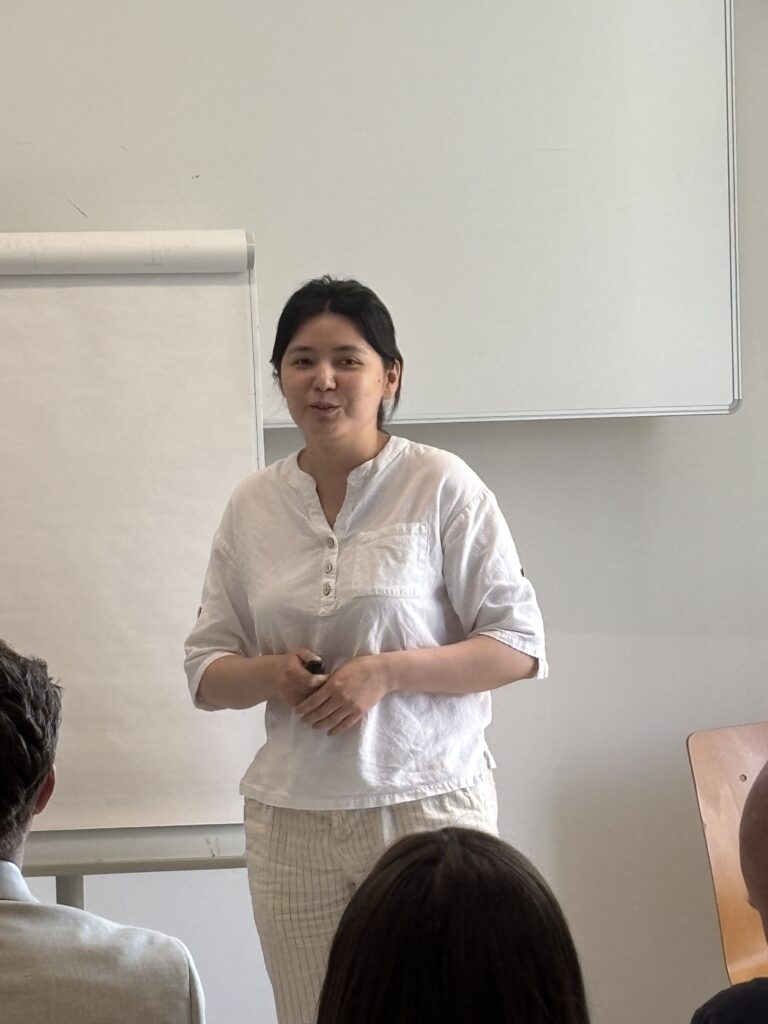
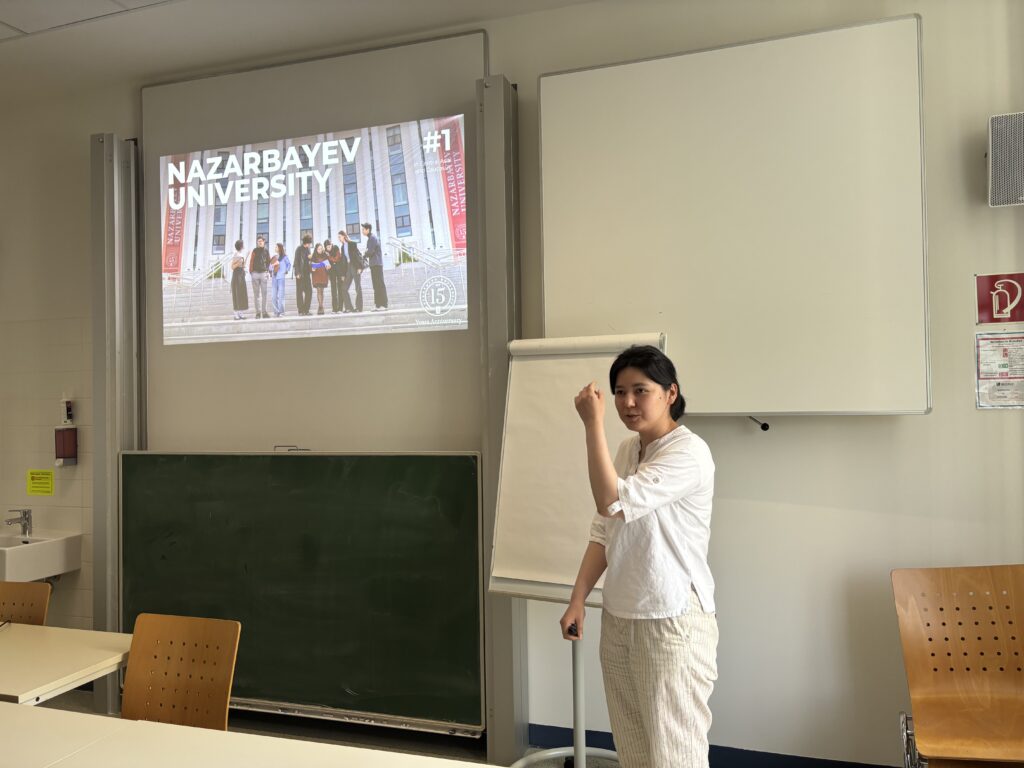
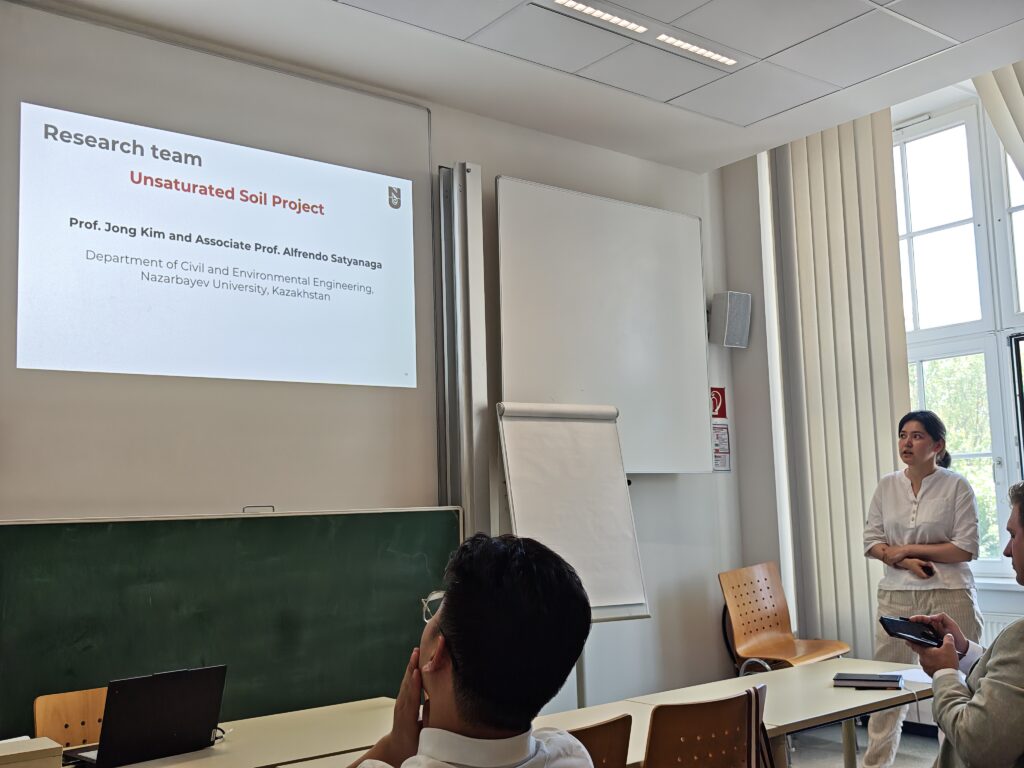
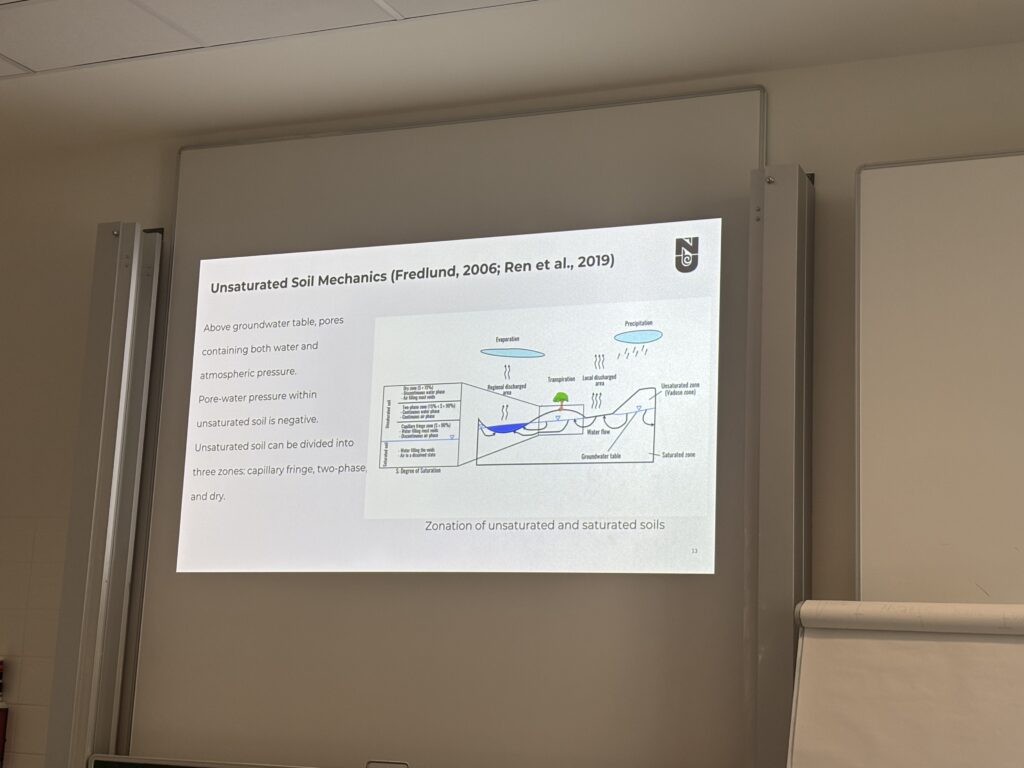
Saltanat Orazayeva’s presentation on SFCC.
(7) Zarina Onopriyenko
Affiliation: Nazarbayev University
Presentation focus: Influence of dual-porosity structure of unsaturated soil on pile bearing capacity
- Investigated the effects of dual porosity and matric suction on pile bearing capacity and settlement.
- Compared unimodal and bimodal pore structures using SWCC and unsaturated-soil mechanics.
- Developed a mathematical framework incorporating bimodal SWCC parameters and suction-dependent shaft resistance.
- Presented numerical settlement analyses for clay under suction and saturated conditions.
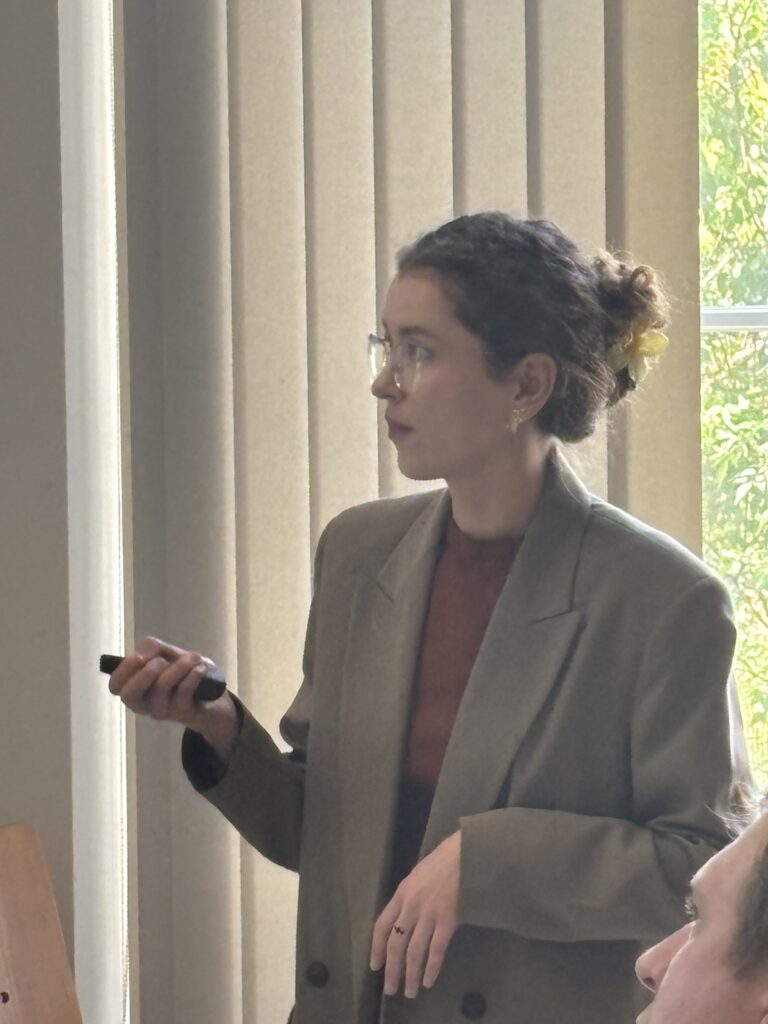
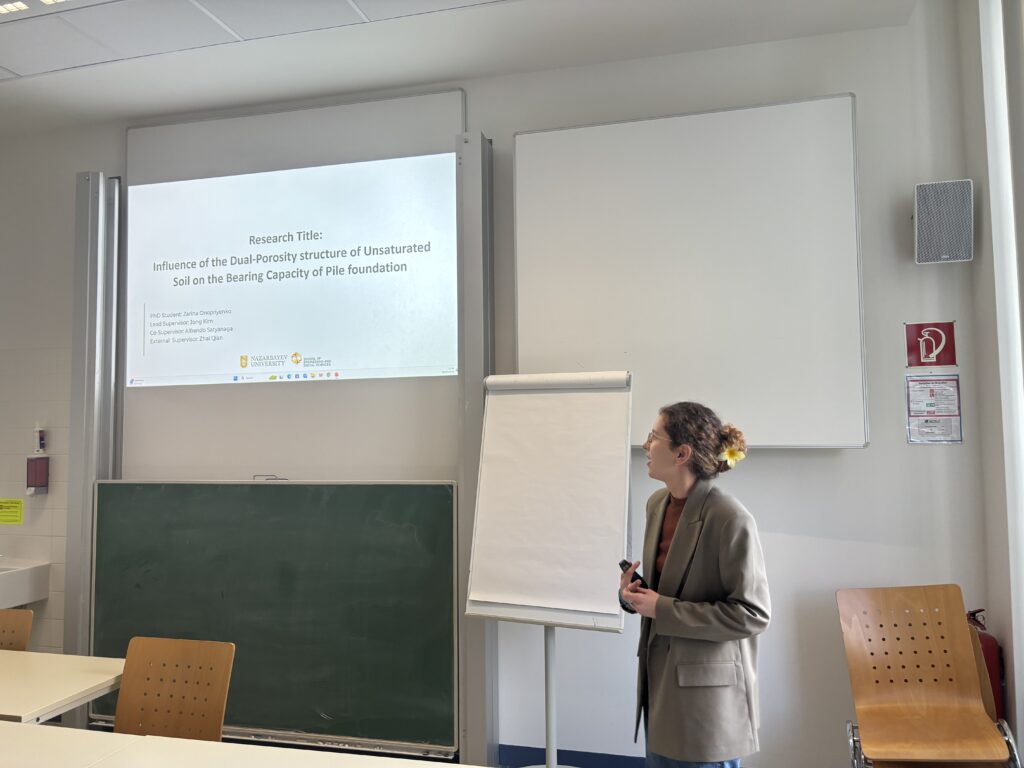
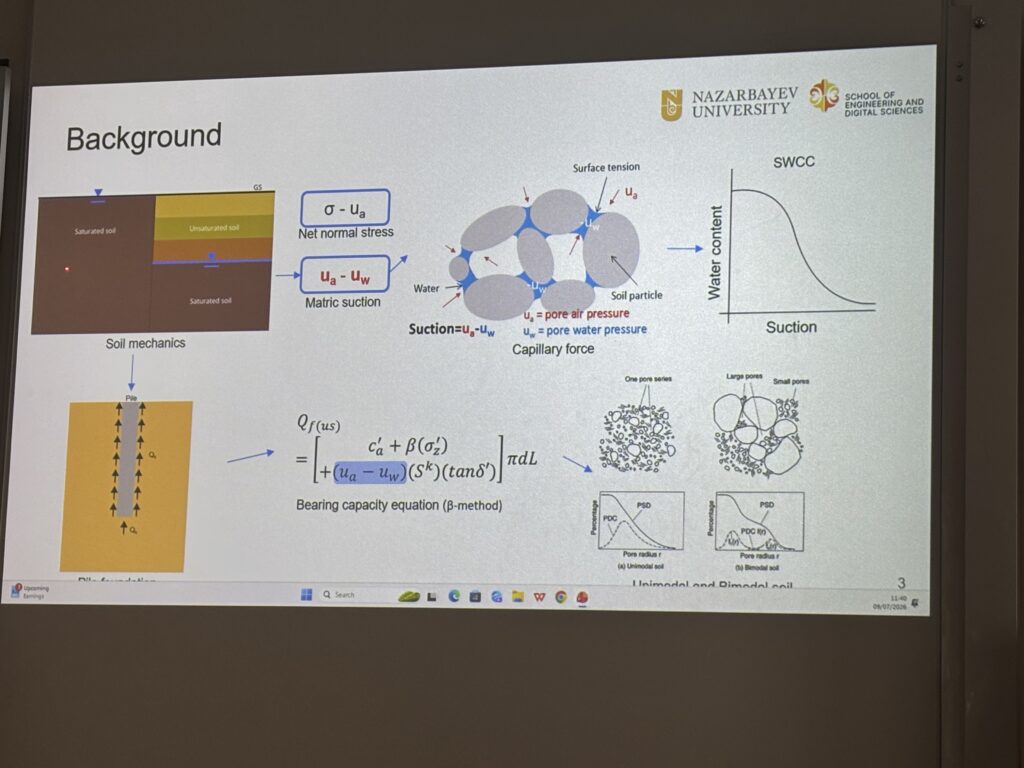
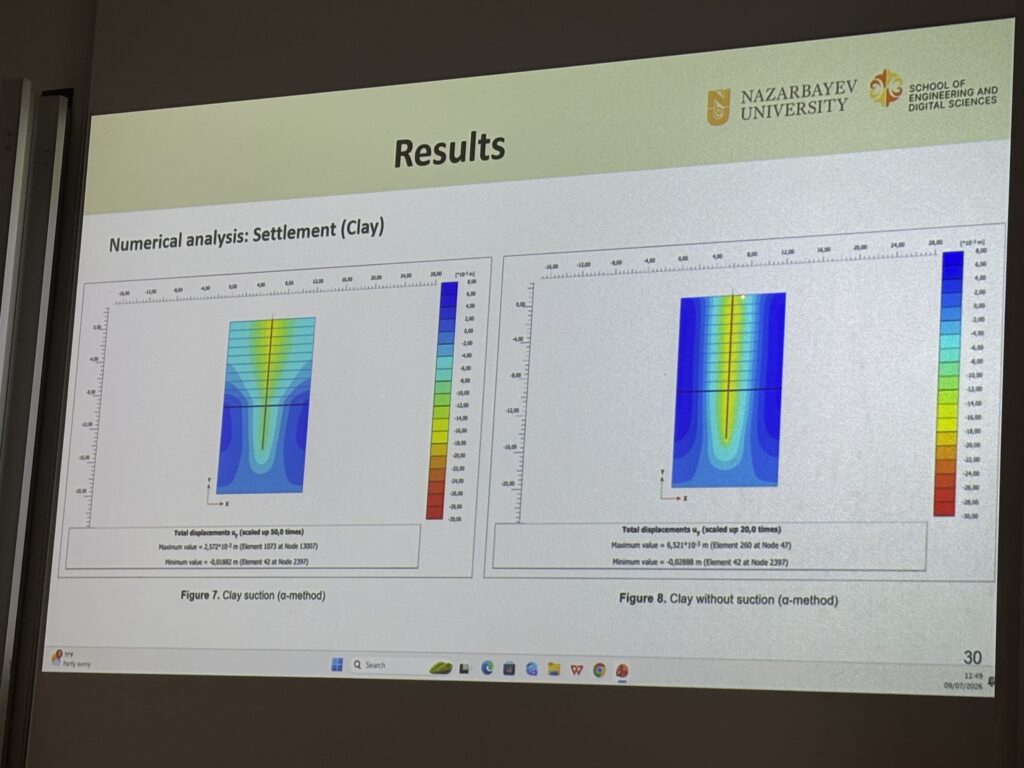
Zarina Onopriyenko’s presentation on SWCC.
(8) Ivan Zaboev
Affiliation: BOKU University
Presentation focus: A numerical study on transient granular flow
- Simulated transient granular flow using the discrete-element method.
- Examined limitations of conventional μ(I) rheology under non-local effects, flow reversal, and transient loading.
- Modelled two-dimensional plane shear with constant normal stress, Hertzian contact, friction, restitution, and particle polydispersity.
- Compared the evolution of friction coefficient μ and inertial number I under different pressures and accelerations.
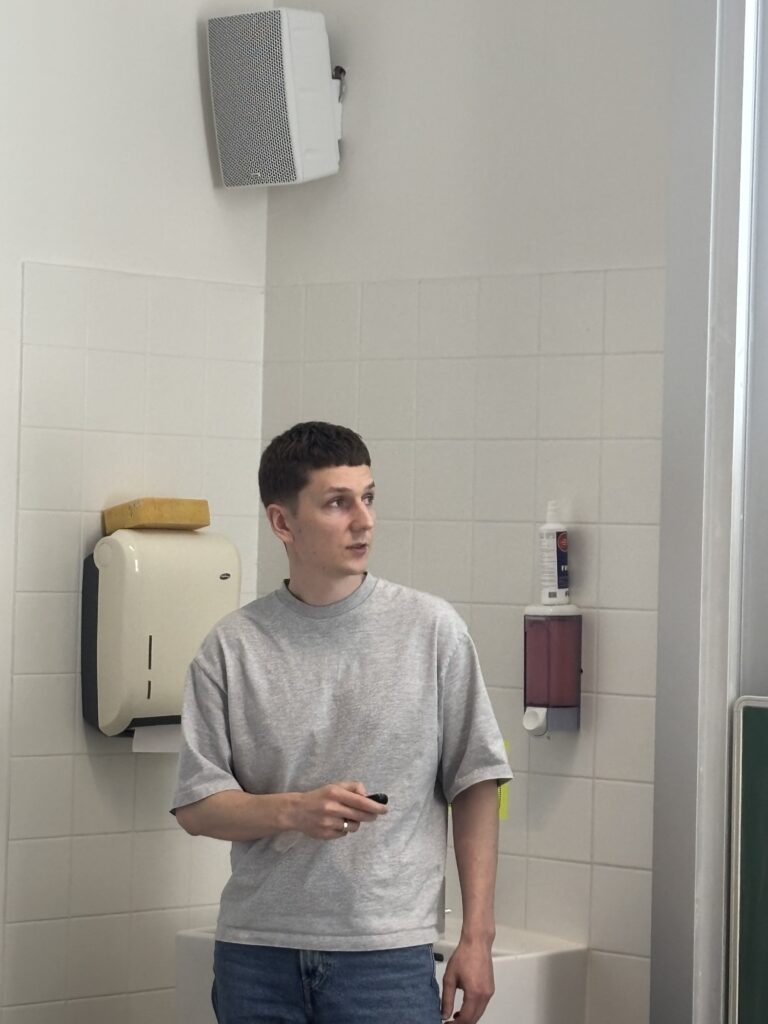
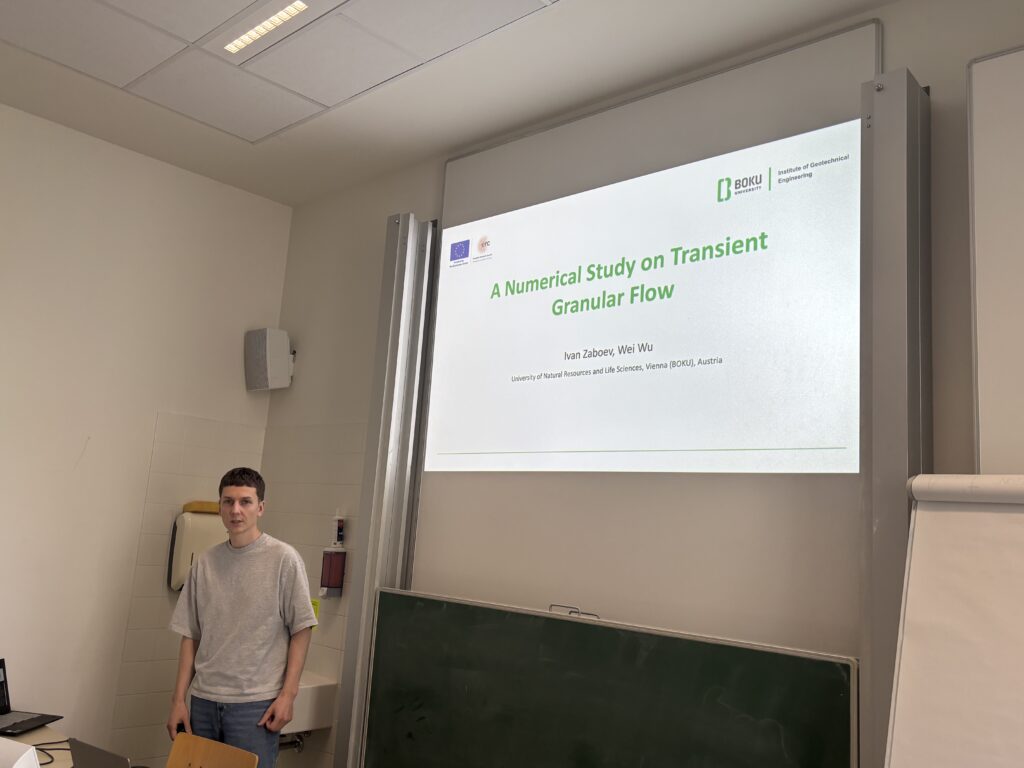
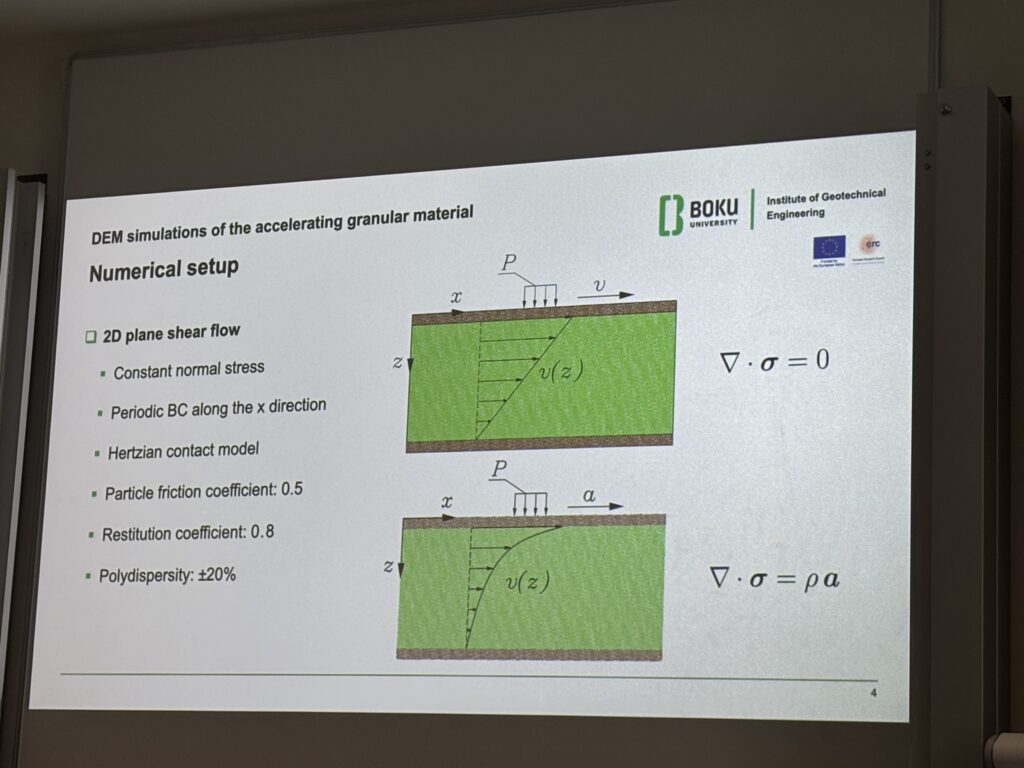
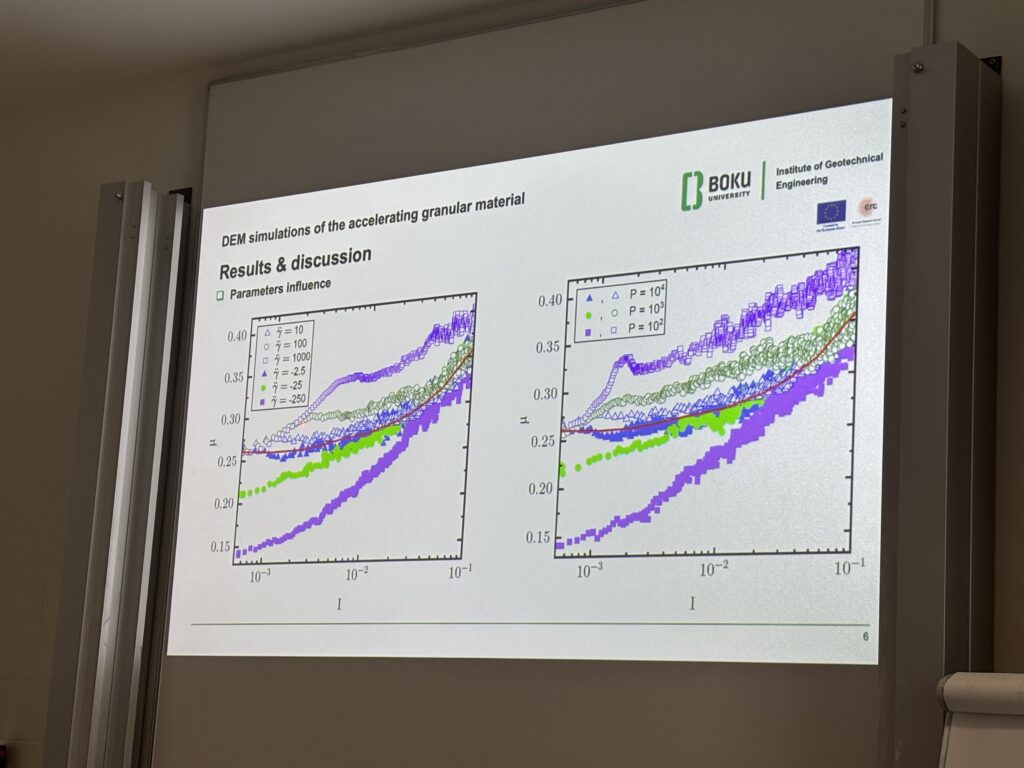
Ivan Zaboev’s presentation on transient granular flow.
(9) Bowen Wang
Affiliation: BOKU University
Presentation focus: Development of a visco-hypoplastic constitutive model for unsaturated clays
- Developed a visco-hypoplastic constitutive model for unsaturated clays.
- Described creep and the elastic–viscous decomposition of the deformation-rate tensor.
- Incorporated creep time lines and suction-dependent compression into the hypoplastic framework.
- Combined time-dependent behaviour with effective-stress concepts to simulate clay deformation under hydraulic and mechanical loading.
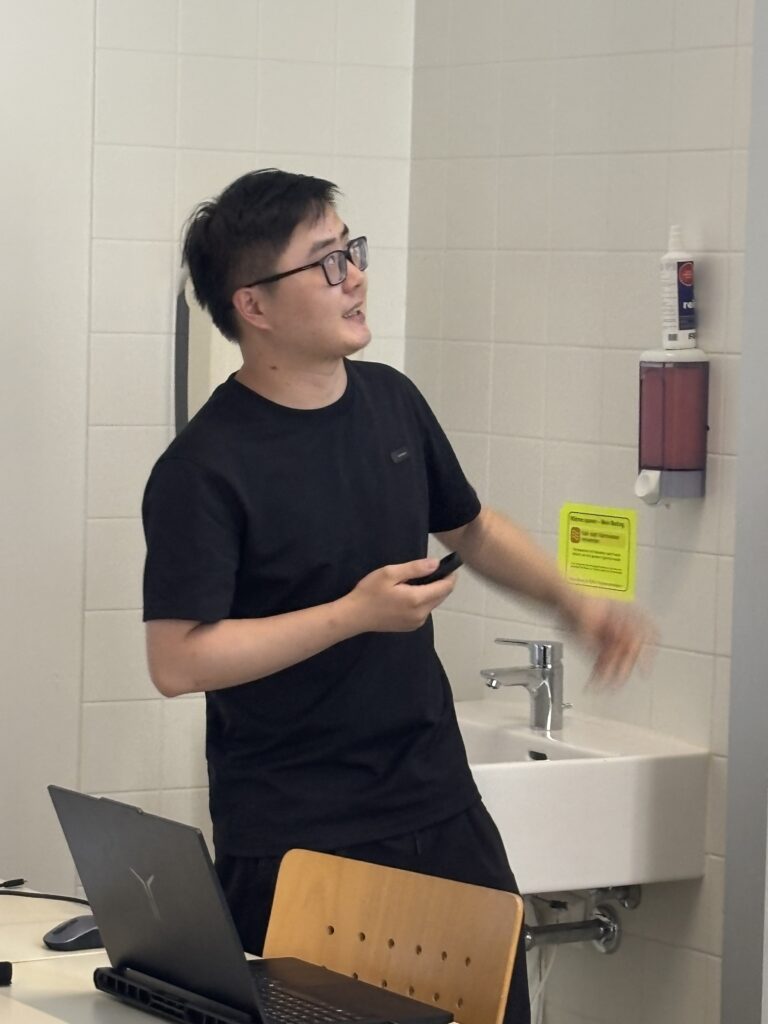
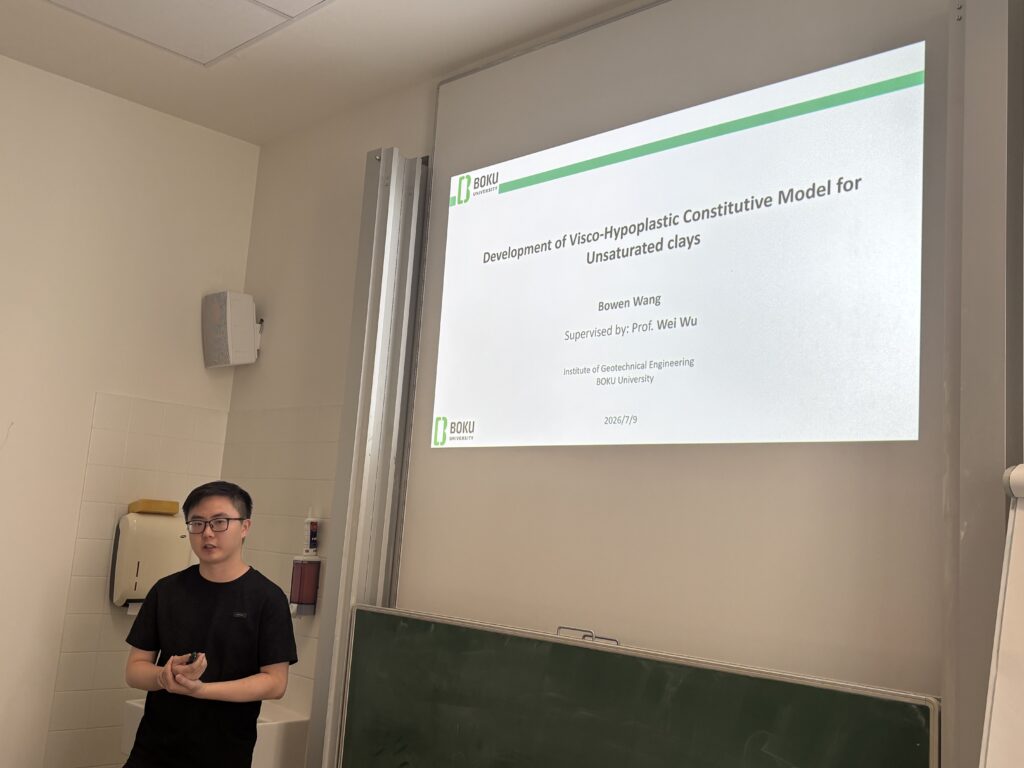
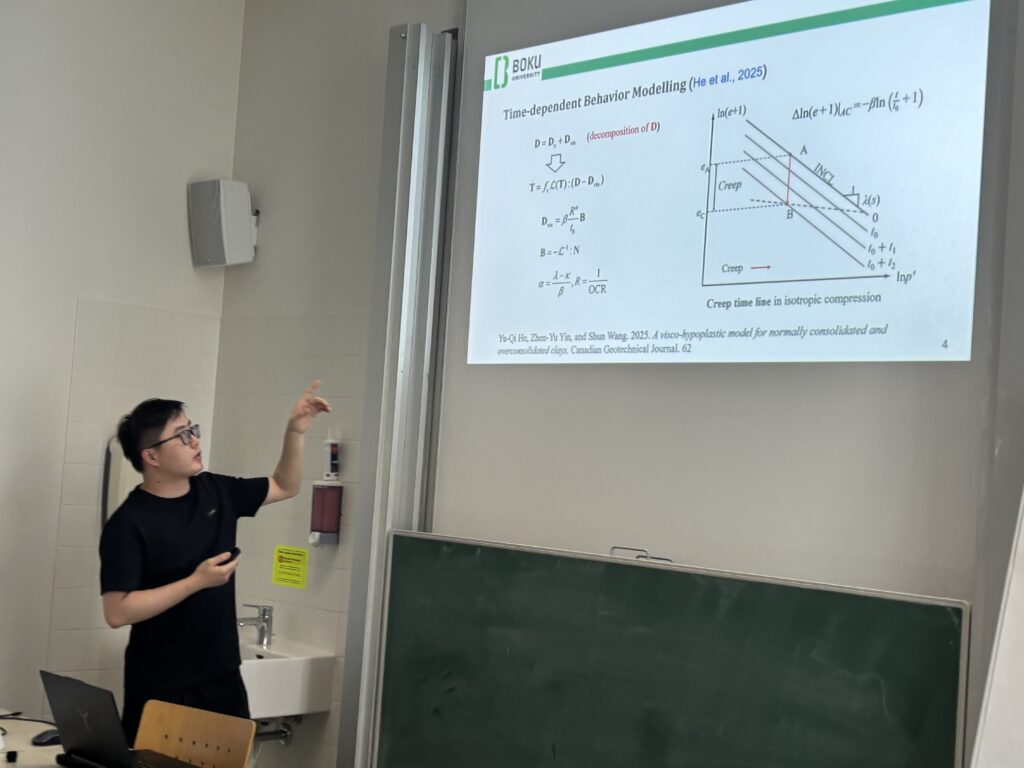
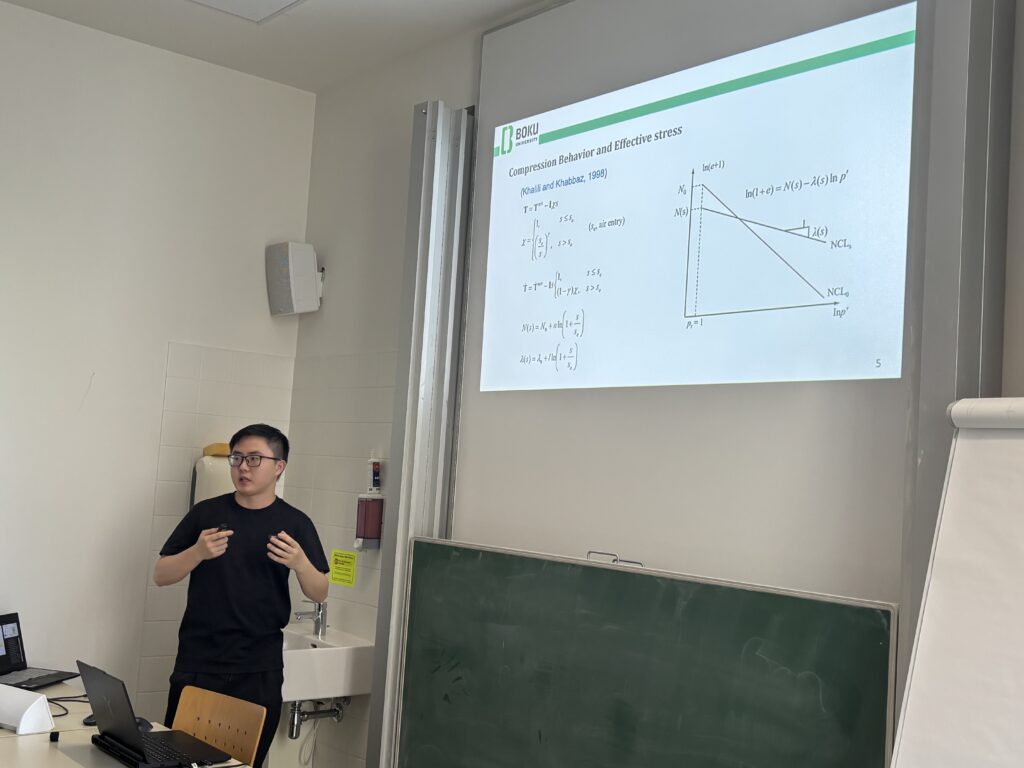
Bowen Wang’s presentation on visco-hypoplastic constitutive modelling.
Outcomes and Future Collaboration
The seminar demonstrated clear thematic complementarity among the participating institutions. Warsaw University of Technology was presented as a major Polish technical university with strong research activity in civil engineering, hydroengineering, infrastructure systems, and geotechnics. Nazarbayev University was represented through the School of Engineering and Digital Sciences, with particular emphasis on its active research programme in unsaturated-soil mechanics and related geotechnical applications.
These institutional profiles provided useful context for interpreting the technical contributions and highlighted the complementary academic backgrounds that shaped the scope of the seminar.
From a scientific perspective, the WUT contributions emphasized laboratory testing, sustainable ground improvement, filtration, distributed monitoring, soil-structure interaction, and geohazard assessment. The NU contributions focused on unsaturated-soil mechanics and its application to infrastructure problems, particularly pile foundations, SWCC/SFCC characterization, and environmental or geohazard systems. The BOKU presentations added numerical and constitutive modelling perspectives for transient granular flows and unsaturated clays. Overall, the programme established a coherent basis for future collaboration in geomechanics, geophysics, monitoring technologies, and computational geotechnics, while contributing to the LOC3G objective of strengthening international and interdisciplinary knowledge exchange.
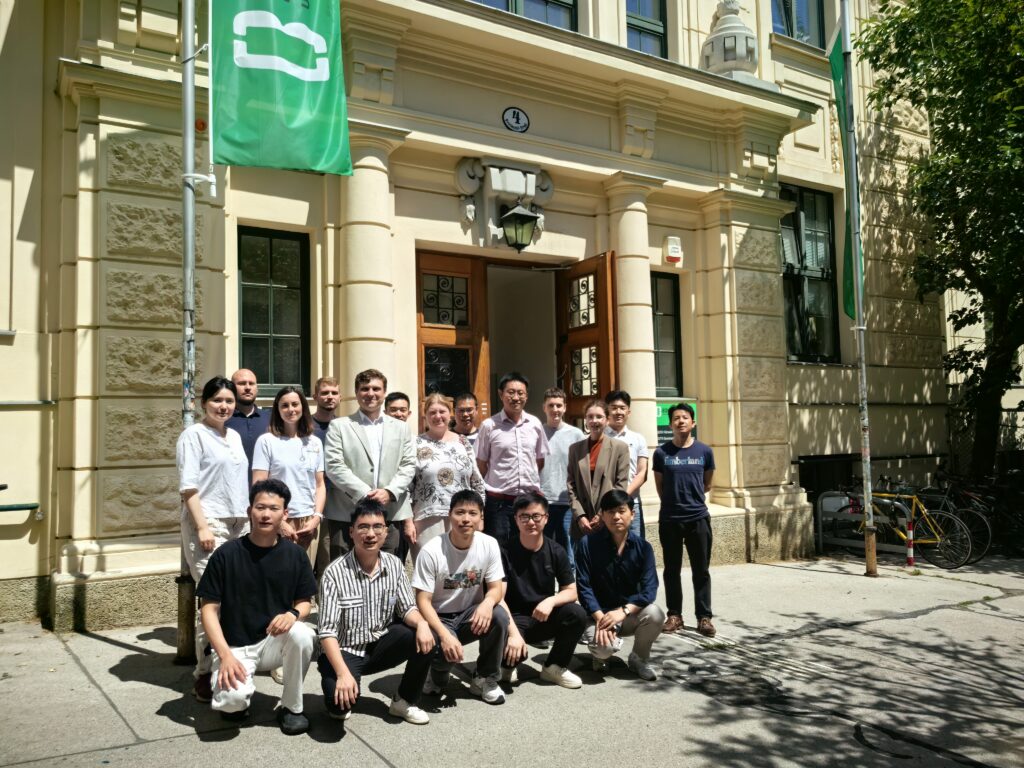
Group photo after the Seminar on Geomechanics and Geophysics.